Microloans through Intermediaries
Microloans and local intermediaries as an approach to constrained farm credit systems in Sub-Saharan Africa
Abstract: Smallholder farmers in Sub-Saharan Africa face persistent barriers to adopting high-impact agricultural technologies due to credit constraints and information asymmetries that exclude them from formal lending markets. This policy note proposes a microloan intervention administered through local intermediaries to enable investment in modern inputs. Evidence from demand-side credit constraints in Nigeria suggests that microloans targeting the most expensive, productivity-enhancing inputs can substantially increase technology adoption while generating demonstration effects that accelerate broader uptake. If successful, such interventions could drive agricultural productivity improvements with particularly large poverty-reduction effects, as estimates indicate farm productivity gains are 11 times more poverty-reducing than growth in other sectors.
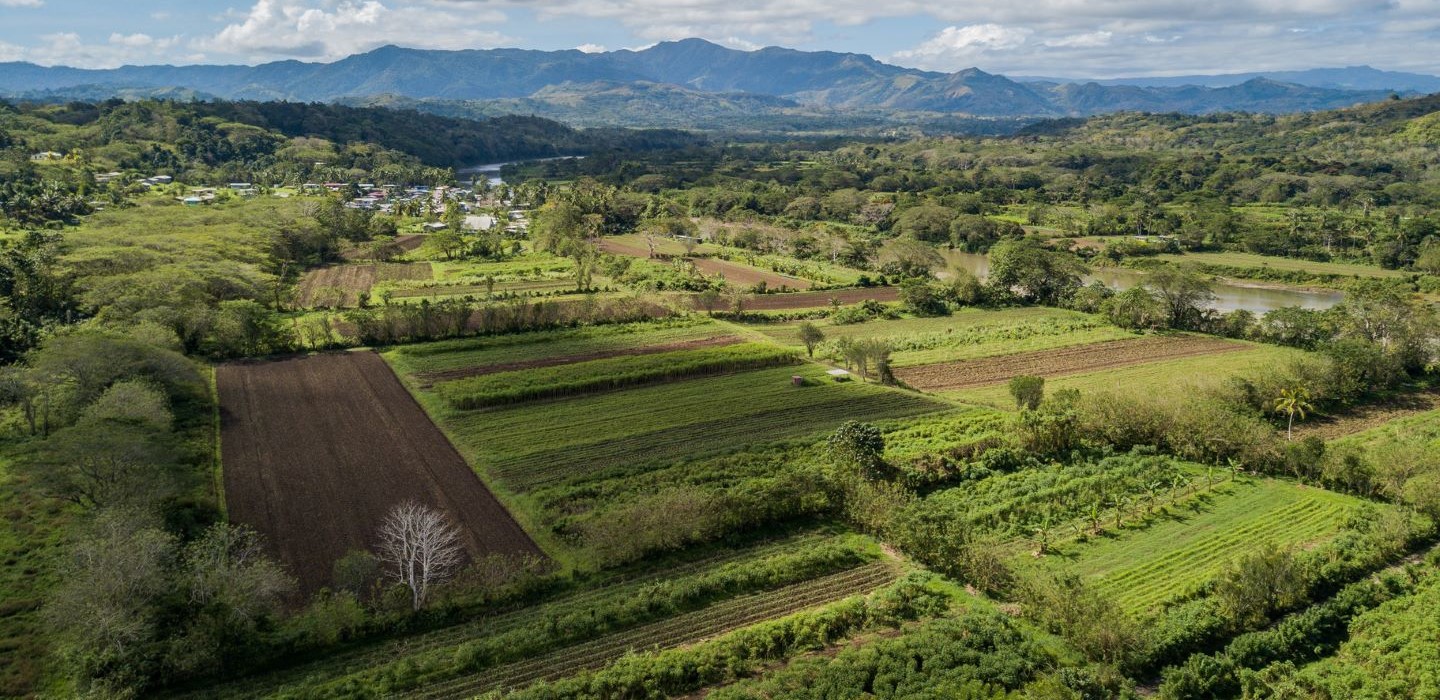
A smallholder farmer grazes goats in the mountains near Shiikh, Somaliland. Robin Hammond / National Geographic
I. Introduction
As food production, raw resources, and biofuel, support much of world around us, sustained agriculture productivity growth is necessary to meet rising global demand. Over the past six decades, world agricultural output has increased at an annual rate of 2.3%, while input use has only grown 1.2% (USDA). This comes with the increase of productivity in the sector, spearheaded by the adoption of modern farming techniques, represented by a 1.1% increase in total factor productivity. Globally, continued gains in TFP have kept us above our break-even point, and has continued to do so with the implementation of modern farming techniques in less developed regions.
In the past decade, agricultural productivity has slowed significantly, prompting a serious reason for concern. The cause of this slowdown can be indicated by the decline in TFP, almost 0.8% in comparison to the decade before. This slowdown has been observed globally.
Sub-Saharan Africa (SSA) controls a quarter of the world’s arable land but produces only a tenth of global output: a gap rooted in slow technology adoption. A major barrier to raising regional productivity is the upfront costs of adopting modern farming techniques, driven by a weakness in both the supply and demand of credit. Empirical evidence from similar SSA contexts demonstrates that credit constraints particularly limit adoption of the most costly, high-impact inputs, namely improved seed and inorganic fertilizer, while less expensive technologies like agrochemicals achieve higher adoption rates regardless of credit access.1 This suggests that financial barriers specifically block access to the most productivity-enhancing technologies.
II. Proposed Intervention
Governments in Sub-Saharan Africa need to support small farmers by providing microloans. Drawing on Uganda’s PRIDE program, this intervention would provide micro-loans to smallholder farmers, enabling investment in higher quality seeds, fertilizers, and land expansion.
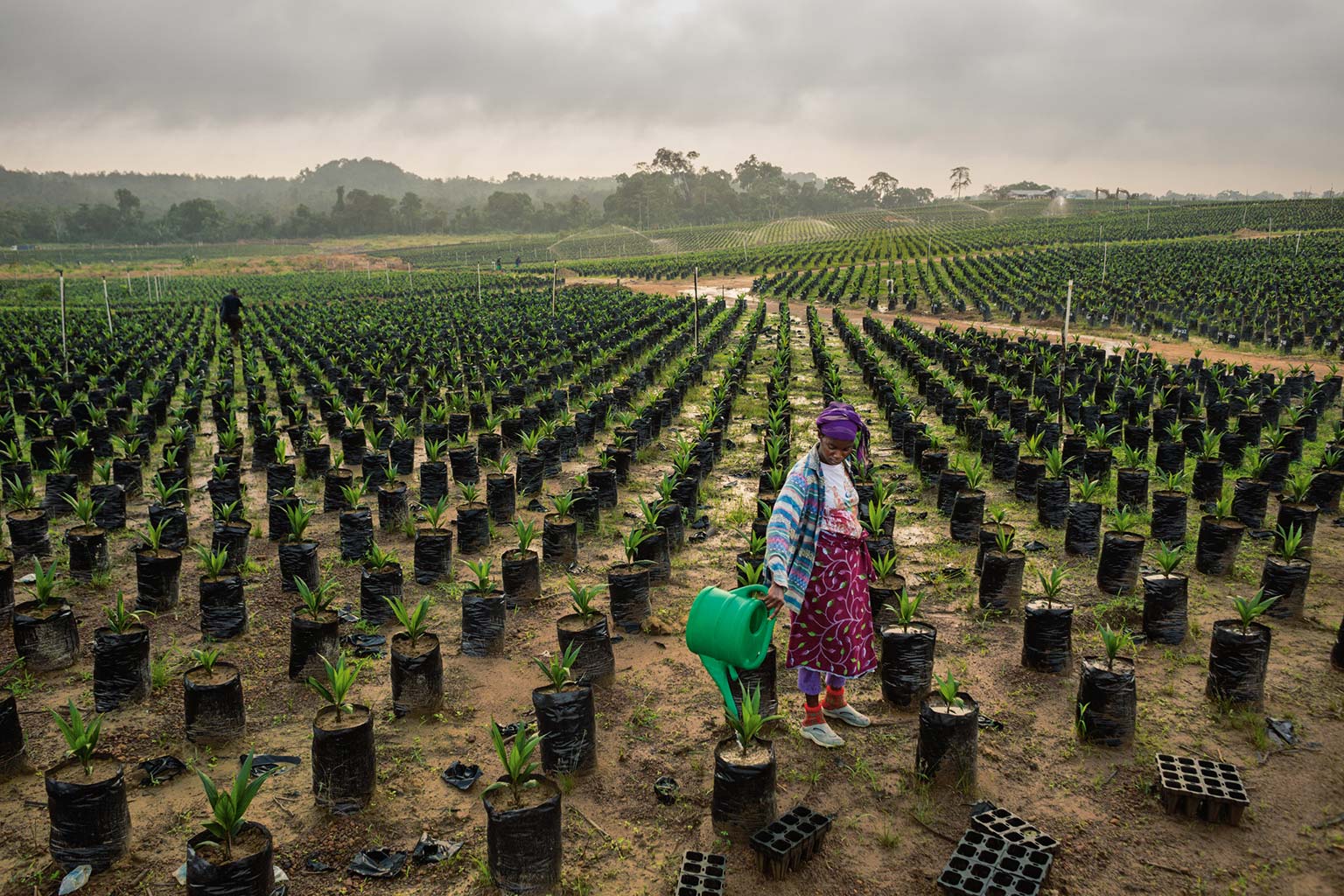
A worker waters oil palm seedlings to be planted in Liberia. Robin Hammond / National Geographic
III. Motivation/Justification for Proposed Intervention
Without traditional forms of collateral, smallholder farmers lack access to formal credit. Volatile harvests create income shocks with no smoothing mechanism, perpetuating poverty cycles. Microloans enable farmers to capitalize on favorable market conditions and smooth consumption across variable harvests.
In their analysis of agricultural technology adoption in Africa, Suri and Udry (2022) find that the lower levels of agricultural productivity do not derive from a single binding constraint, but rather a lack of technology customized to the region. However, data from similar African contexts reveals that financial constraints are particularly binding for the costliest, productivity enhancing inputs. Balana and Oyeyemi’s (2022) analysis of 5,000 Nigerian smallholders demonstrates that credit constraints significantly reduce adoption of inorganic fertilizer and improved seeds, the two inputs with the highest capital requirements, while adoption of less costly inputs like agrochemicals is not significantly constrained by credit. This intervention therefore targets the most consequential constraint: the upfront cost of high-impact inputs.
This intervention is a means of both growth and sustainability for smallholders, promoting more productive techniques and enabling adoption of global advances to their region. This is a medium-sized intervention, as it will alleviate high upfront costs and assist against the rigidity of labor and land markets, without requiring wholesale institutional reform. If successful, the program could generate positive externalities, demonstration effects and knowledge sharing that encourages broader adoption. Moreover, agricultural growth in SSA is particularly effective at reducing poverty, with estimates suggesting farm productivity gains are 11 times more poverty-reducing than growth in other sectors (World Economic Forum). This makes the intervention’s contributions to agricultural GDP especially meaningful for development outcomes.
Alternative Approaches
An alternative intervention, credit subsidies to expand the presence of formal lenders in rural areas, could increase borrowing access. Lakhan et al. (2020) find that government intervention in existing systems can indeed boost borrowing. While credit subsidies could expand borrowing access, they ignore the fundamental problem: formal lenders lack the information to evaluate smallholder repayment capacity.
Empirical evidence from Nigeria identifies specific demand-side barriers that prevent smallholders from accessing formal credit even when it’s available: information asymmetries about credit terms and sources, high transaction costs of formal lending, and risk perceptions that make borrowing feel prohibitive (Balana & Oyeyemi 2022). Without this information, even subsidized credit remains out of reach for farmers without traditional collateral.
Microfinance intermediaries, staffed with local knowledge, overcome this information barrier directly. By reducing information asymmetries, lowering transaction costs through proximity, and building trust relationships that mitigate risk perceptions, they enable credit assessment where formal institutions cannot.
IV. Theory of Change
The long-term goal of this intervention is to increase agricultural productivity by lowering the barriers to technology adoption. The binding constraint is twofold: smallholders lack the upfront capital to purchase high-impact inputs like improved seeds and fertilizers, and weak financial infrastructure means formal credit markets cannot serve them due to missing collateral and information asymmetries.
Balana and Oyeyemi (2022) demonstrate that credit availability is strongly correlated with smallholder technology adoption. Expanding credit access removes adoption barriers, enabling investment in higher quality seeds, pesticides, irrigation, mechanization, and land expansion. On top of this, available credit would allow farmers to benefit from opportune times in land and labor markets to hire additional help or expand their acreage.
Success requires smallholders to accept the risk of borrowing and potential default. If borrowing costs exceed perceived returns, or if farmers view loan sizes as too risky relative to their tolerance, uptake will be limited.
This caution reflects rational responses to genuine agricultural risks. Weather shocks, crop disease, and price volatility all devastate harvests and income. Empirical evidence shows that farmer willingness to borrow increases substantially when risk is managed through insurance or other mechanisms (Balana & Oyeyemi 2022). Local loan officers, with intimate knowledge of local conditions and farm-specific risk profiles, can calibrate loan size and repayment schedules to what farmers can realistically afford even in poor harvest years.
The inputs of this intervention are government-allotted microloans to smallholders, administered through local loan officers who assess borrower creditworthiness and manage repayment.
Program Outcomes Across Time Horizons
The program generates outcomes across multiple time horizons. Immediately, farmers use microloans to adopt improved seeds, fertilizers, and expand land under cultivation. Within the first few years, these investments translate into higher yields. As early adopters demonstrate success, neighboring farmers adopt improved techniques, creating demonstration effects that accelerate uptake.
Over the extended horizon, sustained productivity improvements compound through both direct and indirect channels. Directly, expanded credit enables increased input use and adoption of improved technologies. Indirectly, the established financial infrastructure reduces transaction costs and information barriers, generating spillovers that benefit all farmers. These institutional improvements are the basis for durable productivity gains. The successful loan program establishes a self-sustaining microloan market that enables continued credit access and institutional development, supporting sustained agricultural productivity for future participants.
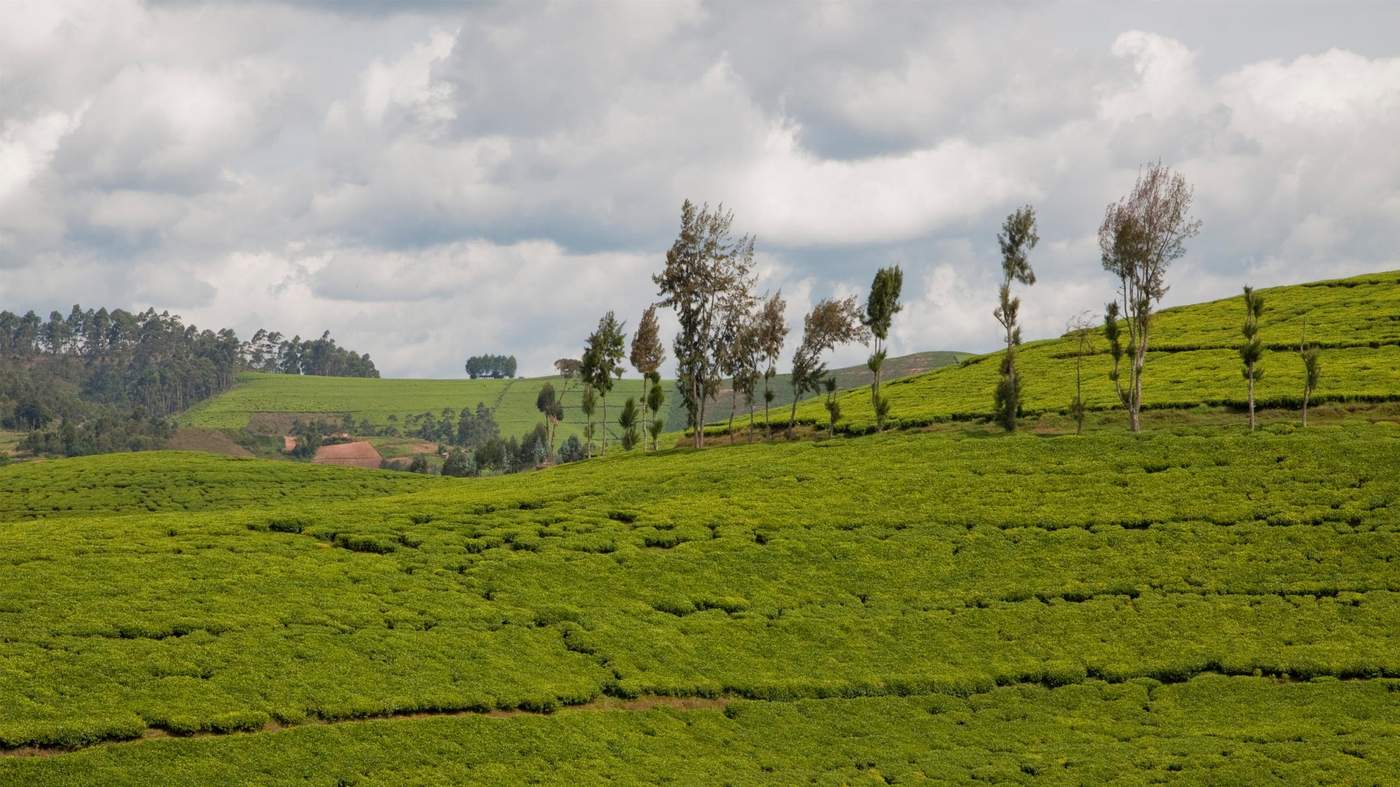
Alfalfa fields in the River Nile region. Nichole Sobecki / National Geographic
V. Potential to Succeed and Possible Caveats
This intervention can succeed because it is not constrained by rigid collateral requirements of traditional financial institutions, nor does it depend on existing rural infrastructure for input distribution.
Implementation Challenges
One potential caveat of this policy is in the difficulties with bookkeeping, leading to rough evaluations of farmer’s ability to repay their loans. Many smallholders do not keep formal records of their harvests, and thus P&L assessment becomes nearly impossible. Typically, these agreements are made verbally with minimal legal documentation. Because of this, loan officers must understand local agricultural conditions and accurately assess farmer profitability.
Because lenders cannot value smallholder assets, they cannot use traditional collateral requirements. This program must therefore accept nontraditional collateral such as perishable goods, livestock, or land rights, accepting higher default risk in exchange for broader access.
Risk and Mitigation
If hardships lead to significantly poor yields, whether from extreme weather or blight, loan recovery becomes impossible. Risk-aversion among smallholders poses a genuine constraint: If perceived loan sizes exceed household risk tolerance or expected returns, uptake will be limited, particularly during agricultural downturns when farmers underestimate technology returns.
These constraints are real, but they are also precisely why this intervention is designed as it is. Local loan officers can assess individual farmer risk profiles and adjust loan terms accordingly. They can build relationships that survive poor harvests. Farmers with insurance coverage or access to reliable extension services are significantly more likely to borrow.2 The program’s strength lies not in ignoring these constraints but in working within them. Formal lending institutions cannot do this.

A mix of smallholder and larger plantations on farming land outside Maputo, Mozambique. Robin Hammond / National Geographic
1 Balana and Oyeyemi (2022), Table 7, find that credit constraints reduce fertilizer adoption (p<0.05) and seed adoption (p<0.001), but not agrochemicals. This differential effect suggests credit is binding specifically for expensive inputs.
2 Balana and Oyeyemi (2022) find that households with insurance coverage are 6.1% less likely to be demand-side credit constrained, suggesting that risk management mechanisms can substantially increase borrowing participation.
Citations
Balana, Bedru B., and Motunrayo A. Oyeyemi. 2022. “Agricultural Credit Constraints in Smallholder Farming in Developing Countries: Evidence from Nigeria.” World Development Sustainability, 1: 100012.
Jayaram, K., J. Riese, and S. Sanghvi. 2010. “Agriculture: Abundant Opportunities.” McKinsey Quarterly.
Lakhan, A. 2020. “Credit Constraints and Rural Farmers’ Welfare in an Agrarian Economy.” Heliyon. https://doi.org/10.1016/j.heliyon.2020.e05333
Suri, Tavneet, and Christopher Udry. 2022. “Agricultural Technology in Africa.” Journal of Economic Perspectives, 36(1): 33–56.
USDA Economic Research Service. “International Agricultural Productivity.” https://www.ers.usda.gov/data-products/international-agricultural-productivity/
World Economic Forum. “3 Ways to Transform Agriculture in Africa.” https://www.weforum.org/stories/2016/05/3-ways-to-transform-agriculture-in-africa/